The Things We Carry Into December
On faith, belonging, and finding a new place for the beautiful things we carry with us.
I remember the happiness I felt when I embraced Islam.
There was something extraordinary about that moment. A sense of certainty I had rarely experienced before. As though something I had been searching for, perhaps without even knowing I was searching, had finally found its name.
I remember talking to my best friend. We were happy, excited, and somewhere in the middle of that happiness, a rather unexpected thought entered my mind.
“Oh my God. What about Christmas?”
I know. Of all the profound questions one might contemplate after embracing a new faith, apparently my mind decided that Christmas needed an urgent meeting.
But underneath that slightly ridiculous moment was a surprisingly meaningful question. One that would only begin to reveal itself as the months passed.
You see, Christmas had never meant quite what people might assume it meant to me.
I grew up in an Orthodox Christian family. Our Christmas was celebrated on January 7, with its own traditions, religious significance, and spiritual meaning.
But the Christmas I eventually fell in love with was something different.
It was a Christmas I discovered while living and working abroad. A season of beautiful colours, sparkling lights, carefully wrapped presents, handwritten cards, and that almost inexplicable warmth that seems to settle over people as December approaches.
I fell in love with the idea that, for a little while, the world collectively agreed to make room for magic.
Santa Claus wasn’t a religious figure in my imagination. He was a symbol of hope, of childhood wonder, of that beautiful possibility that something unexpected and kind might happen simply because someone wanted to make you smile.
And somewhere along the way, I began creating my own traditions.
Every year, I designed my own cards, wrapping paper, stickers, and little details. Not because I needed another seasonal project, although anyone who knows me will tell you I have never needed much encouragement to create one.
I did it because I loved the thought of someone arriving at work and discovering a small present waiting on their desk.
The possibility that a handwritten message might arrive on a day when someone desperately needed to feel appreciated.
That a tiny, carefully considered detail could quietly tell another human being:
I thought about you. You matter. You are worth the effort.
For me, Christmas became less about a particular day and more about a state of mind.
An entire season devoted to making ordinary moments feel extraordinary.
And then I found Islam.
Or perhaps, in ways I am still learning to understand, Islam found me.
Ramadan became one of the most profoundly beautiful experiences of my life. Its magic was entirely different.
It wasn’t the magic of sparkling lights or wrapped gifts. It was the quiet beauty of reflection, prayer, gratitude, discipline, and an extraordinary awareness of Allah’s presence in my everyday life.
It was deeply personal.
It offered me a kind of spiritual connection that I had never experienced quite so completely before.
And I was certain.
I still am.
When I go to bed at night, it is Allah I turn to. When I wake up, it is Allah I remember.
There is a quiet certainty in that relationship. One that has settled into the ordinary moments of my life so naturally that sometimes I forget just how much has changed.
And yet, as we prepare to enter December, I find myself looking at something familiar through completely different eyes.
Not questioning my faith.
Simply wondering where to place a tradition I have loved for so many years.
And perhaps that is one of the quieter, less discussed experiences of being a revert.
People often speak about the beauty of finding Islam. The peace, the certainty, the transformation.
And all of those things are real.
But we speak less often about the ordinary little moments that follow.
The moments when you encounter something familiar and suddenly realize that you are experiencing it from a completely different place in your life.
You haven’t stopped loving the people you loved before.
You haven’t forgotten the memories that shaped you.
And you haven’t necessarily lost your affection for the little traditions through which you once expressed kindness.
But suddenly, you find yourself wondering how all these things fit together.
Sometimes I find myself explaining this before anyone has even asked. As though affection for something familiar needs an explanation now.
It isn’t that I feel uncertain about the direction my life has taken.
It’s that I am learning how to live a familiar life through a beautifully unfamiliar perspective.
This year, I decided to approach December a little differently.
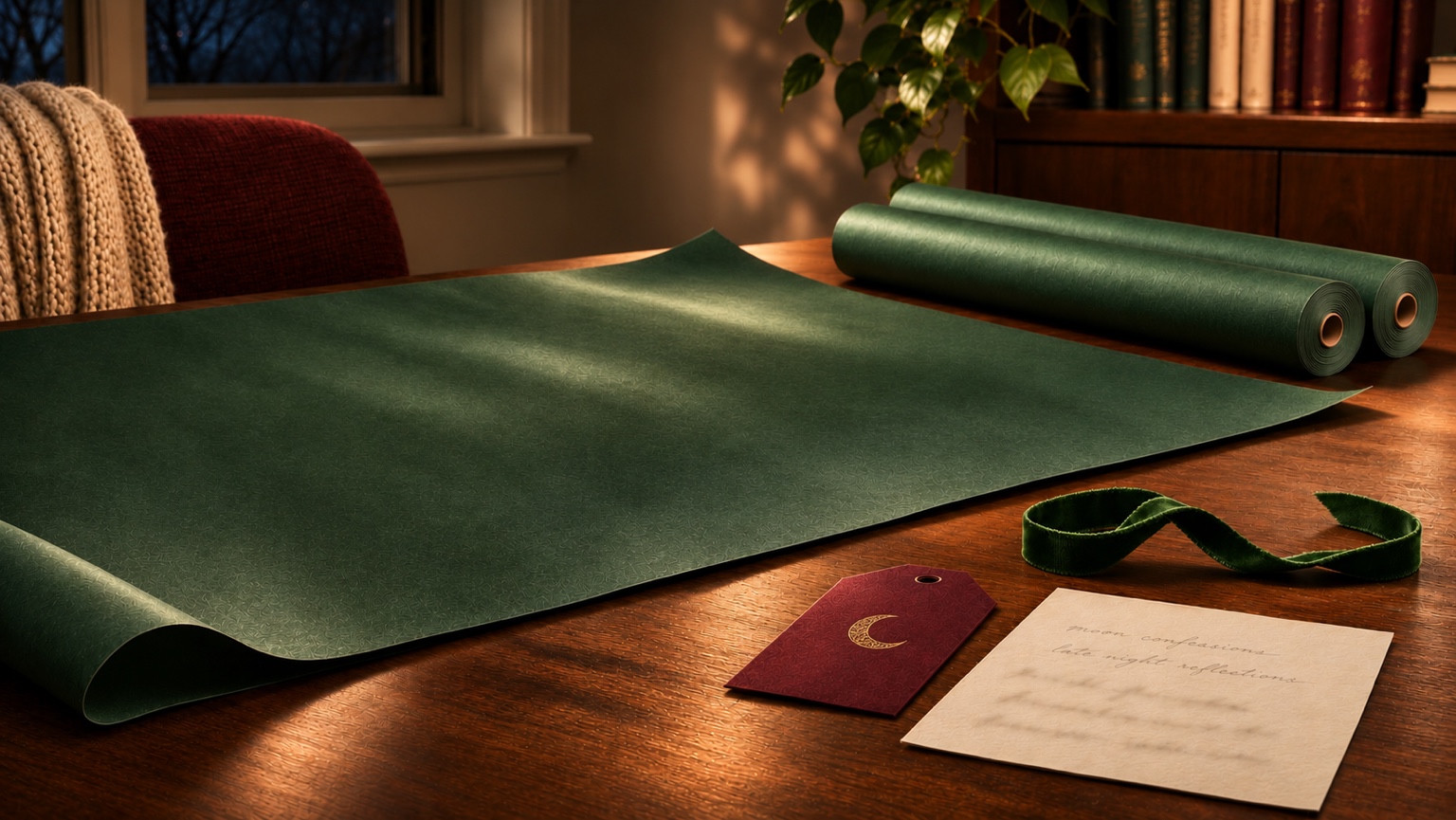
I am still preparing my gift collection. Still spending an arguably unreasonable amount of time thinking about wrapping paper, ribbons, cards, and all those tiny details that make a present feel personal.
But this year, I have called the collection MORE of what matters.
There are no Christmas greetings, no Santa Claus, no Christmas trees.
Instead, there are familiar festive colours, carefully considered details, heartfelt messages, and even a tiny crescent moon quietly woven into the design.
A small, personal acknowledgment of the faith that has become the centre of my life.
And somehow, it feels right for where I am today.
Because when I remove the familiar symbols and look at what remains, I still recognize the reason I fell in love with this season in the first place.
Kindness.
Generosity.
Thoughtfulness.
The beautiful, almost childlike excitement of making somebody else happy.
My best friend and I even have our own tradition called 25 Days of Kindness.
Every day, we open a letter written by the other person, inviting us to perform one act of kindness.
Sometimes it is something we do for ourselves. Sometimes it is for someone we love. And sometimes it is for a complete stranger who will never know who was behind it.
We might leave an encouraging message somewhere in public, donate to someone in need, or surprise a stranger with flowers.
Twenty-five little opportunities to make the world feel just a fraction more beautiful than it did the day before.
And perhaps this is where I begin to understand why the thought of losing these traditions makes my heart feel so heavy.
Because somewhere along the way, they became more than seasonal activities.
They became part of how I express love.
Part of how I remind people that they matter.
Part of how I make sense of the kind of person I want to be in this world.
And now, at the beginning of a new chapter in my life, I am simply learning how those parts of me might find a new expression.
But I am beginning to understand that the experience of embracing Islam doesn’t happen in isolation from everything that came before it.
We don’t arrive at Islam as blank pages.
We arrive with entire lives behind us.
With childhood memories, family traditions, friendships, complicated histories, and little things that have quietly become part of how we understand love.
Finding faith gives us a new way to understand ourselves and the world around us.
Learning how to bring our lives into that understanding takes time.
So as December approaches, I find myself surrounded by the familiar colours and materials of a tradition I have loved for years, preparing to give them a slightly different meaning.
There is something strangely beautiful about that.
I don’t know what it will look like next year, or five years from now.
For the moment, I am content to discover what it looks like today.
Perhaps what I have been afraid of losing was never really Christmas itself.
Perhaps it was the little world of generosity, imagination, and love I had built around it.
And perhaps I don’t have to lose that world.
Perhaps I simply have to learn how to let it grow with me.
Moon Confessions